

ENCODED Research Reference Library
A comprehensive list of peer-reviewed research supporting the scientific mechanisms underlying ENCODED.
ENCODED is grounded in validated findings across psychology, neuroscience, identity research, cognitive science, behavioral economics, and neuroplasticity. This research reference library provides full transparency into the scientific foundation behind ENCODED.
Identity, Self-Concept & Identity-Based Motivation
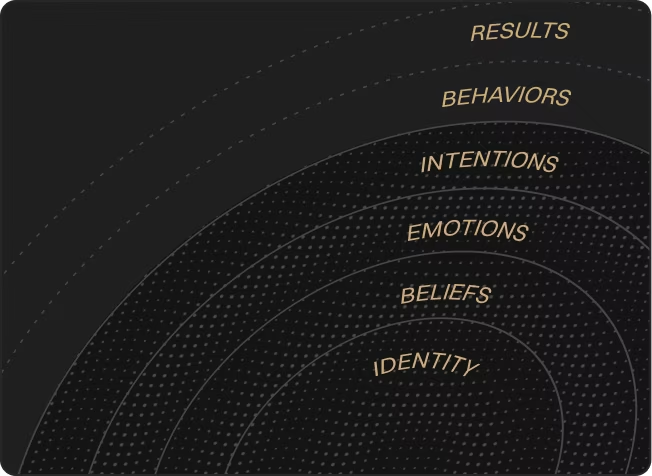
Behavior is driven more reliably by identity than by goals, intentions, or willpower. When actions align with 'who I am,' they occur automatically and consistently.
ENCODED stabilizes self-identity and reduces internal conflict, allowing aligned behaviors to emerge without relying on motivation, discipline, or force.
Seeing the Destination Makes the Path Easier
When a desired identity feels like part of “who you are,” motivation increases automatically and people take actions aligned with that identity. Difficulty is interpreted as meaningful rather than discouraging.
Possible Selves and Academic Outcomes
Students with vivid future identities show higher motivation and significantly better academic outcomes. The more real the future identity feels, the stronger the behavior change.
Identity-Based Motivation: Implications for Health and Health Disparities
Identity is context-driven and changes behavior when activated. Clear identity anchoring improves follow-through and resilience under difficulty.
Self-Identity and the Theory of Planned Behavior
People reliably act in line with their self-identity ("I am a healthy person") even more than with intentions or attitudes. Identity predicts behavior.
Green Identity and Behavior
When people see a behavior as part of their identity, they perform it more consistently and automatically.
Self-Concept Clarity
Clear identity reduces anxiety, increases confidence, and improves emotional stability and decision quality.
Day-to-Day Relationships Among Self-Concept Clarity, Self-Esteem, and Daily Well-Being
Identity clarity strongly predicts daily emotional well-being and resilience to stress.
Narrative Identity & Future Self
Humans are guided by internal narratives about who they are becoming. A vivid, coherent future self increases motivation, persistence, and meaning under difficulty.
ENCODED strengthens future-self continuity, making long-term actions feel immediately relevant and reducing the psychological distance between intention and execution.
The Psychology of Life Stories
People form identity through stories about themselves; rewriting the story rewrites identity and behavior.
Possible Selves
Imagining clear future selves increases motivation and organizes present behavior.
Self-Efficacy, Agency & Motivation
The belief that one’s actions can produce desired outcomes (self-efficacy) directly predicts effort, resilience, and follow-through under uncertainty.
ENCODED rebuilds perceived agency by reinforcing identity-consistent evidence, restoring trust in one’s ability to act effectively and influence outcomes.
Self-Efficacy: The Exercise of Control
Belief in one’s capability is one of the strongest predictors of motivation, resilience, and behavior.
Self-Efficacy and Work Performance
High self-efficacy reliably leads to better performance and improved outcomes across domains.
Belief, Attitude, Intention, and Behavior
Beliefs create attitudes, which create intentions, which drive behavior—the foundation of ENCODED’s belief architecture.
The Theory of Planned Behavior
Behavior is shaped by beliefs, perceived capability, and identity-like self-perceptions.
Beliefs, Cognitive Appraisal & Emotional Regulation
Emotional responses are driven by interpretation, not events themselves. Shifting core beliefs and appraisals changes emotional reactions before they escalate.
ENCODED updates belief structures at the identity level, reducing emotional reactivity and enabling calmer, more adaptive responses to stress and uncertainty.
Emotion and Adaptation
Emotions are driven by our interpretations, not events. Changing interpretation → changes emotional response.
Patterns of Cognitive Appraisal
Emotional states correspond to specific thought patterns. Shift thoughts → shift emotions.
Antecedent- and Response-Focused Emotion Regulation
Reappraisal (changing thoughts before reacting) significantly reduces negative emotional intensity.
Decreasing Negative Affect Using Reappraisal: A Meta-Analysis
Across many studies, reappraisal reliably decreases stress and negative emotion.
The Free-Energy Principle
The brain predicts reality based on beliefs; updating beliefs reduces perceived threat and emotional reactivity.
Predictive Brains, Situated Agents
Perception and emotion are filtered through belief-based predictions; belief updates change behavior and emotional response.
Autonomic Nervous System & Stress Regulation
Chronic stress dysregulates the autonomic nervous system, impairing cognition, emotional control, and decision-making capacity.
ENCODED promotes internal coherence and predictability, supporting nervous system regulation and restoring access to higher-order cognitive functions.
A Model of Neurovisceral Integration
Emotional regulation and cognitive control are directly tied to nervous system function and HRV.
Heart Rate Variability as an Index of Emotional Regulation
Higher HRV corresponds with better emotional stability and stress handling; psychological training improves HRV.
Decision-Making, Cognitive Load & Clarity
High cognitive load degrades judgment, slows decisions, and increases avoidance. Clarity reduces mental friction and accelerates action.
ENCODED reduces internal noise and competing signals, freeing cognitive resources for faster, more confident, and more consistent decision-making.
Cognitive Offloading
Offloading thoughts (writing things down) reduces mental strain and enhances problem-solving.
The Adaptive Decision Maker
Decision speed and quality improve when information is simplified or structured.
Working Memory and Reasoning
Working memory constraints cause overthinking; reducing load accelerates reasoning.
Stress and Risk Taking
Stress impairs decision-making; reducing emotional reactivity improves accuracy.
Journaling, Reflection & Behavior Change
Structured reflection increases self-awareness, insight, and behavioral adjustment by making internal states explicit and examinable.
ENCODED uses guided reflection to surface patterns, resolve internal contradictions, and reinforce identity-aligned choices over time.
Self-Distancing Reduces Emotional Reactivity
Reflecting from a third-person perspective lowers emotional intensity and improves clarity.
The Impact of Reflection on Goal-Directed Self-Regulation.
Structured reflection supports better goal achievement and motivation.
Handwriting, Encoding & Expressive Writing
Writing by hand engages deeper cognitive processing and memory encoding than passive or digital inputs, strengthening learning and integration.
ENCODED leverages handwritten expression to embed identity-consistent beliefs more deeply, increasing retention, embodiment, and follow-through.
The Pen Is Mightier Than the Keyboard
Handwriting promotes deeper understanding and memory because it forces conceptual processing.
Handwriting Enhances Letter Recognition
Handwriting activates motor and visual neural systems, improving learning and recall.
The Effects of Handwriting Experience
Writing by hand activates learning-related brain regions significantly more than typing.
Writing About Emotional Experiences
Writing helps people process emotional experiences, reducing stress and improving clarity.
Expressive Writing and Working Memory
Writing reduces cognitive load and frees mental bandwidth, improving clarity and decision-making.
Neuroplasticity, Reconsolidation & Repetition
Neural pathways are reshaped through repeated activation. Memory reconsolidation allows beliefs and emotional associations to be updated with new information.
ENCODED applies consistent, identity-aligned repetition to rewire outdated patterns and stabilize new, adaptive internal models.
The Organization of Behavior
Repeated thoughts strengthen neural pathways (“neurons that fire together, wire together”).
Myelin—More Than Insulation
Repetition increases myelin, speeding up thought and making patterns more automatic.
The Plastic Human Brain Cortex
Repeated practice reorganizes brain networks, even in adults.
Reconsolidation and the Stability of Memory
When recalled, beliefs and memories become changeable; they can be updated with new information.
Memory Reconsolidation: Updating Stored Memories
Emotional memories and belief patterns can be rewritten when activated correctly.
Preventing the Return of Fear
Fear responses can be eliminated by updating memories during the reconsolidation window.
Social Roles and Identity Consistency
Behaviors repeated in alignment with identity strengthen that identity and make behavior automatic.
Behavior Change & Habit Formation
Sustainable behavior change occurs when actions are congruent with identity and supported by reduced friction, not increased effort.
ENCODED addresses the root drivers of behavior—identity, beliefs, and regulation—so habits form naturally as expressions of the self, not forced routines.
Healthy Habits: Persistence Without Effort
Habits formed through repeated identity-aligned actions become effortless and automatic.
Identity and Habit
Habits form most easily when they align with who someone believes they are.
Summary
ENCODED is grounded in robust, multidisciplinary research on identity, beliefs, neuroplasticity, emotional regulation, decision-making, habit formation, and behavior change. This reference library provides full transparency into the scientific foundations supporting the ENCODED methodology

